
Cheap flights to Gdańsk
Set your departure airport and maximum budget: SniperAir tracks prices to Gdańsk and alerts you the moment a deal matching your criteria appears.
Quick summary
Country
Poland
Continent
Europe
Airport
GDN
Currency
Polish zloty (PLN)
Time zone
UTC+1 (UTC+2 in summer)
Deals already spotted to Gdańsk
Real flight examples detected by SniperAir, with their reference price.
Loading examples…
Why track Gdańsk with SniperAir
You do not need to compare prices every day
Choose your departure
Enter your departure airport and your maximum budget for a flight to Gdańsk (GDN).
SniperAir keeps watch
Our systems continuously compare new prices with the real price history of the route. SniperAir monitors prices and alerts you: it does not sell or book tickets.
You receive an alert
As soon as a price matches your criteria, you are notified, without having searched for anything yourself.
Airport and getting into town
An airport about 12 km out, with its own railway station
Gdańsk Lech Wałęsa (GDN)
Lech Wałęsa Airport lies west-northwest of the centre, about 12 km from Gdańsk, 10 km from Sopot and 23 km from Gdynia, according to Wikivoyage (EN). Most flights are operated by low-cost carriers such as Ryanair and Wizz Air, says the same source. A railway station has served the airport since the PKM line opened in 2015 (Wikipedia DE); trains reach the centre via Gdańsk Wrzeszcz, and buses, including route 210 to the main station, fill in the rest.
Distances and times are approximate, from Wikivoyage (EN, DE) and Wikipedia (FR, DE); schedules change, so check them before you travel. We do not quote fares.
Gdańsk has about 487,000 residents (Wikipedia DE, EN) and forms the Tricity (Trójmiasto) with Sopot and Gdynia, a conurbation of well over a million people. Wikipedia (EN, ES) dates the first written record to 997, around the mouth of the Motława on Gdańsk Bay. Wikivoyage (DE) lists Malbork and the Hel Peninsula among the usual day trips.
Landmarks
The Long Market, the Motława crane, Mariacka Street and the quays
Gdańsk was a Hanseatic League port and once the biggest and richest city in the Polish kingdom, says Wikivoyage (EN). The city lay almost entirely in ruins at the end of the Second World War, and the old town has been painstakingly rebuilt. The places below are illustrated; St. Mary's Church, Westerplatte and Oliwa are described at the end of the section.
The crane and the Motława
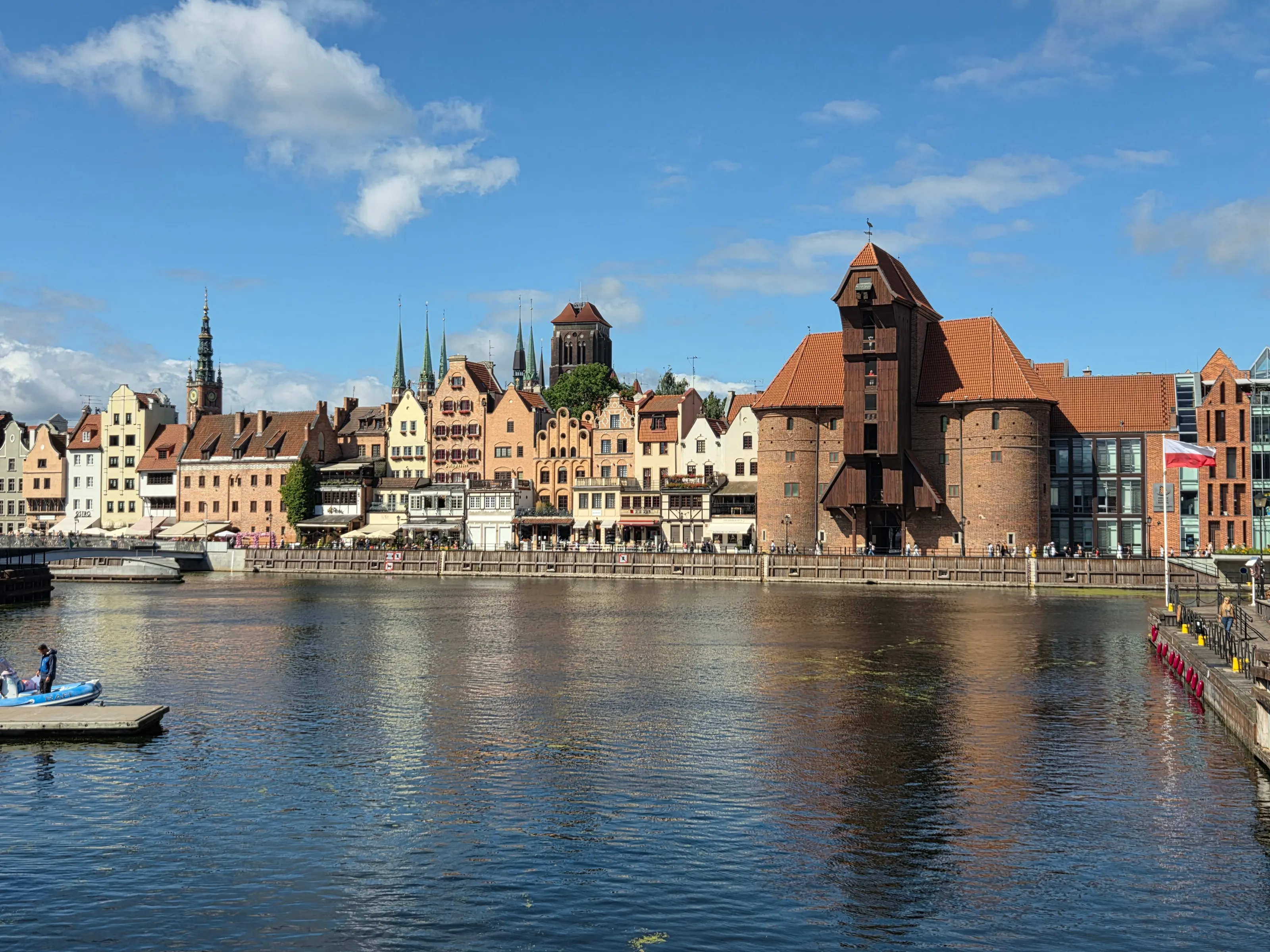
The old port crane (Żuraw) is first mentioned in 1367 and is one of the best-known buildings in Gdańsk, says Wikivoyage (EN). Partly destroyed in the war and rebuilt, it was handed to the National Maritime Museum in 1962 and now houses an exhibition on the former port. Its two brick towers are reflected in the river, lined with the houses of former merchants.
Neptune and the Long Market
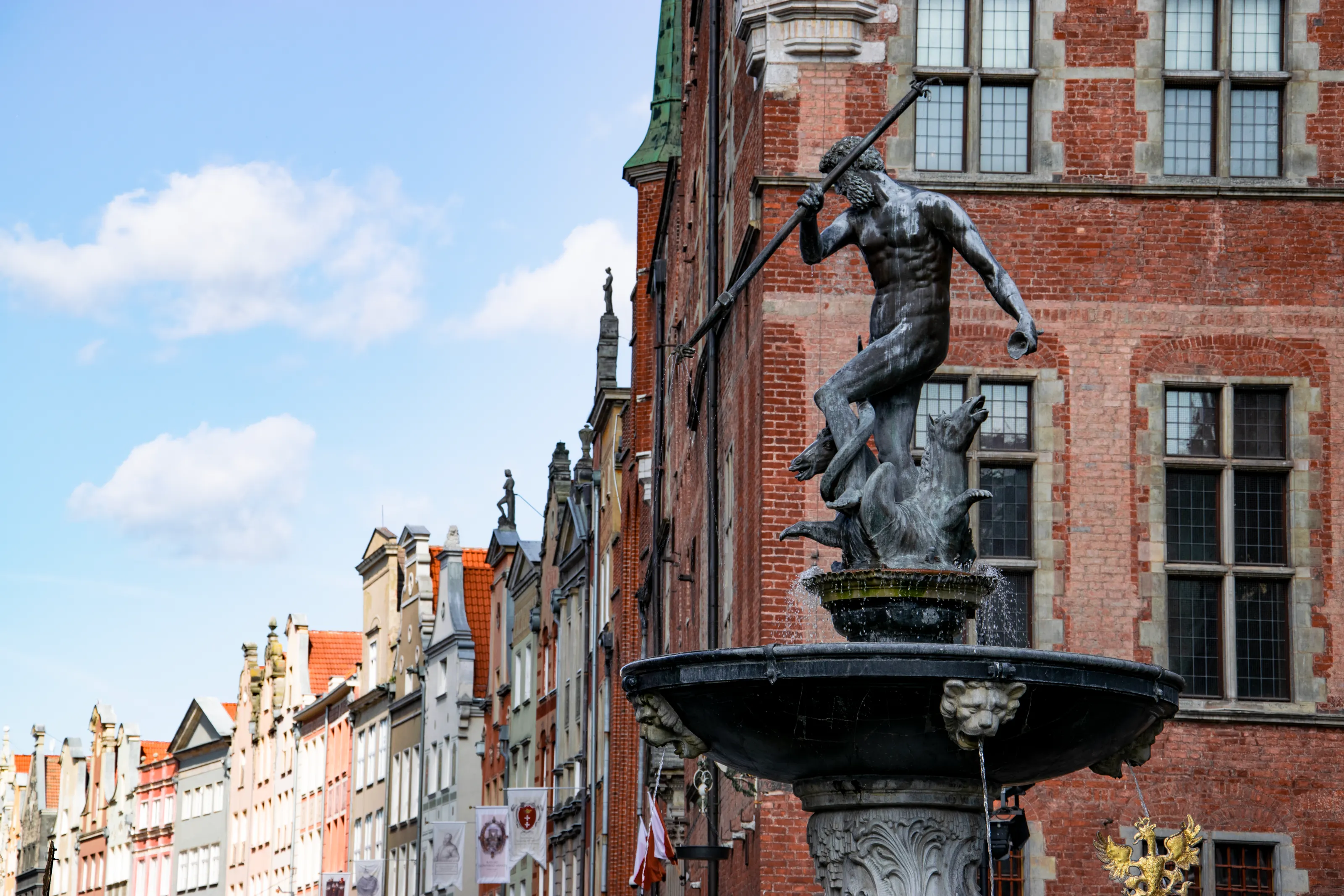
Neptune's Fountain stands on the Long Market (Długi Targ) and ranks with the Town Hall, the Green Gate and Artus Court among the city's best-known landmarks, per Wikipedia (EN). The Long Market and Long Street together form the Royal Way, the longest surviving medieval urban axis, says Wikivoyage (DE). The narrow decorated facades recall the city's merchant golden age.
Mariacka Street
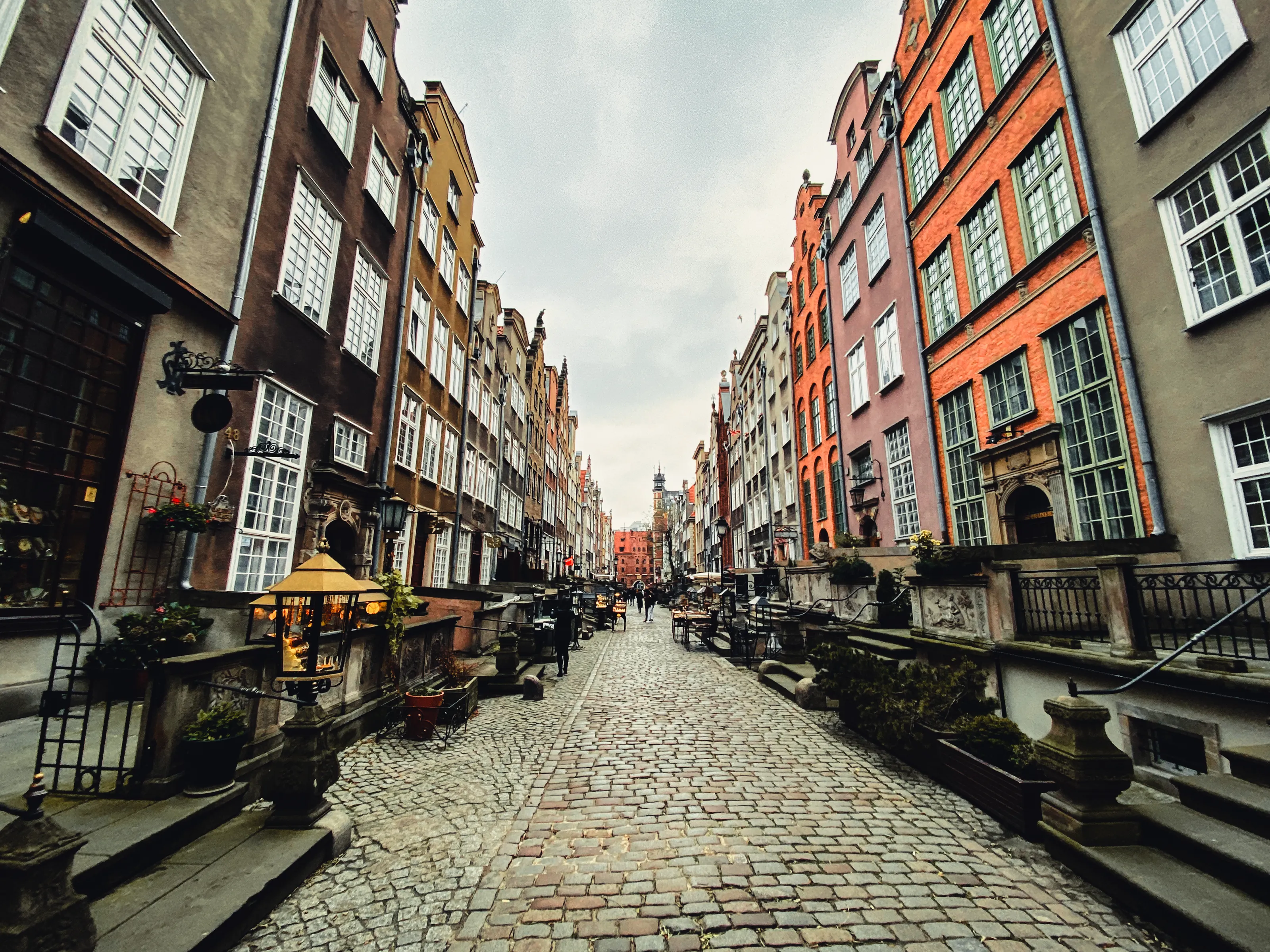
Mariacka Street, listed by Wikipedia (FR) among the city's most important monuments, is a cobbled lane lined with houses with front stoops; Wikivoyage (DE) lists it among the craft streets, and amber is a signature product, Gdańsk being nicknamed the world capital of amber (Wikipedia FR).
The Motława quays
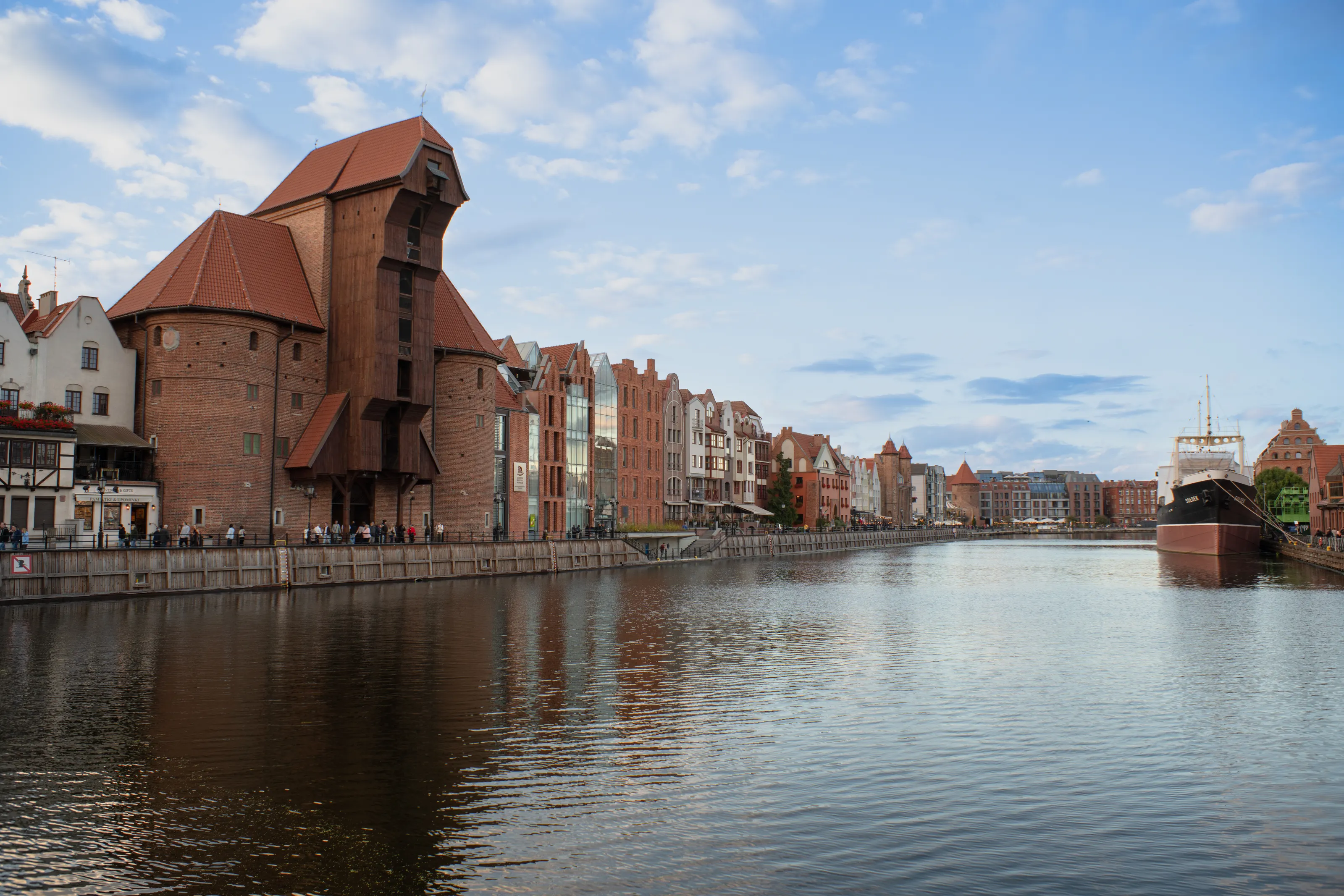
The quays, the crane and the gabled houses make up the best-known image of Gdańsk. Wikivoyage (EN) notes excursion boats here and, from April to November, water trams to the Hel Peninsula leave from the Green Gate (Wikivoyage DE). A large old-style sailing ship is sometimes moored for pleasure cruises.
St. Mary's, Westerplatte and Oliwa
St. Mary's Church is the largest brick church in the Baltic region per Wikivoyage (DE) and one of the largest brick churches in the world per Wikipedia (EN); it was built to hold 25,000 people (Wikivoyage DE). Westerplatte, where the first battle of the Second World War took place in September 1939, is a memorial park about 20 minutes away by bus, says Wikivoyage (EN). Oliwa, to the north, adds its former cathedral and Abbots' Palace (Wikipedia FR, ES).
Museums and culture
The Museum of the Second World War and the European Solidarity Centre
Museum of the Second World War
Housed in an unusual skewed building, the Museum of the Second World War recreates a Polish street of 1930 and a shell-damaged scene with a T-34 tank, according to Wikivoyage (EN). It is closed on Mondays per the same source; check opening hours.
Solidarity and recent history
Gdańsk is the birthplace of the Solidarity movement, led by Lech Wałęsa, who won the Nobel Peace Prize in 1983 and became Poland's first post-communist president, says Wikivoyage (EN). The European Solidarity Centre, listed by Wikipedia (EN), tells the story of the movement that helped bring down the regime; Wikipedia (ES) mentions the shipyard where it was born.
The National Maritime Museum
The museum runs, among other sites, the port crane and the Sołdek, Poland's first ocean-going vessel, launched in 1948 and closed in winter according to Wikivoyage (EN). Wikivoyage (DE) also mentions a 90-day pass covering the city's museums. We do not quote fares because they change.
Food and drink
River fish, pierogi, pancake bars and Goldwasser
Fish and home cooking
Wikivoyage (EN) notes fish stalls on the Motława riverbank and many places serving traditional Polish food: pierogi, home-style dishes, steak tartare. Restaurants on the Long Market and Szeroka Street are busy in summer.
Goldwasser and drinks
Danziger Goldwasser, a root and herbal liqueur flecked with gold and produced since the 16th century, is considered the city's drink according to Wikivoyage (EN, DE); it is now made in Germany. Machandel juniper vodka is regaining popularity (Wikivoyage EN). Craft breweries across the river complete the picture.
St. Dominic's Fair
The Jarmark św. Dominika, a fair running for three weeks from the last weekend of July, has a tradition of almost 750 years and draws millions of visitors according to Wikivoyage (DE); food stalls concentrate around Targ Węglowy, Targ Rybny and Szeroka Street.
Getting around
On foot in the centre, trams and fast rail to Sopot and Gdynia
On foot and by bike
The old town is an easy walk from the main station, with the Royal Way linking the main sights (Wikivoyage DE). Cobbles and stoops call for good shoes.
Tram, bus and SKM
Trams and a dense bus network complement the fast SKM rail link between Gdańsk, Sopot and Gdynia, per Wikivoyage (DE) and Wikipedia (DE). Wikivoyage (DE) recommends a 72-hour ticket covering the Tricity.
Boats and beaches
In season, boats leave the Green Gate for Hel; the beaches of Gdańsk Bay (Brzeźno, Stogi, Jelitkowo) are well-equipped tourist areas, very busy in high summer according to Wikivoyage (DE).
Budget and precautions
A large port city that is good value, with prices to check by season
Price level
Wikivoyage (EN) lists a wide range, from cheap bars to pricier restaurants. We give no figures because we could not cross-check them on two independent open sources; prices vary with the season and neighbourhood.
Busy periods
Beaches and quays are packed in summer, and St. Dominic's Fair draws crowds in July and August. Book early.
Flying and precautions
SniperAir tracks prices to GDN and compares them with the route's history, but it does not sell or book tickets. Check entry requirements for Poland for your nationality with the official authorities. At the Baltic seaside, obey bathing flags and local instructions.
When to go
Mild summers and cold winters: May to September for beaches and terraces
Spring (March to May)
Cool and changeable. Quayside terraces reopen gradually; a good time for the old town with fewer crowds.
Summer (June to August)
Mild: July and August average highs of about 22 °C per Wikipedia (DE). Summer has the most rainy days according to Wikipedia (EN). Beach season and St. Dominic's Fair.
Autumn (September to November)
Increasingly cool, with golden light on the brick facades. The beaches empty.
Winter (December to February)
Cold and sometimes snowy, and the Motława can freeze; winters are rather dry per Wikipedia (EN). Christmas markets enliven the old town.
Gdańsk sits between oceanic and continental climates according to Wikipedia (EN, DE), with cold winters and mild summers. We give no detailed monthly averages because sources differ.
By length of stay
What to do in Gdańsk depending on how long you stay
The old town
The Long Market, Mariacka Street, St. Mary's Church, the crane and a stroll along the Motława quays.
Memory and amber
The Museum of the Second World War, the European Solidarity Centre, Westerplatte and Oliwa.
Tricity and coast
Sopot, Gdynia, the Hel Peninsula and Malbork Castle, with Gdańsk as your base.
In pictures
Gdańsk in pictures
You might also like
Similar destinations
FAQ
Frequently asked questions about flights to Gdańsk
How do I get from Gdańsk airport to the centre?
The airport (GDN) is about 12 km from the centre. A railway station serves it, with trains via Gdańsk Wrzeszcz, and buses also run to the main station. Check schedules before you go.
When is the best time to visit Gdańsk?
May to September for the quays, the beaches and St. Dominic's Fair (late July); winter is cold, but the Christmas markets have their charm.
Is Gdańsk expensive?
Wikivoyage describes a range from cheap bars to pricier restaurants. We quote no figures because we could not cross-check them on two independent sources.
How long should I stay in Gdańsk?
Two days for the old town; three to four with the museums, Westerplatte and Oliwa; more for Sopot, Gdynia, Hel and Malbork.
What is there to see near Gdańsk?
Sopot and Gdynia (the Tricity), the Hel Peninsula, Malbork Castle and the beaches of Gdańsk Bay.
What should I eat in Gdańsk?
River fish, pierogi, traditional Polish cooking and Danziger Goldwasser; amber is the signature craft.
How much does a flight to Gdańsk usually cost?
The price depends mainly on your departure city, the time of year and how far ahead you book. The "opportunities" section above shows real examples of prices SniperAir has already detected to this destination.
How do I get alerted when a flight to Gdańsk drops below my budget?
Create an alert profile with your departure airport, Gdańsk as the destination and your maximum budget. You are notified automatically as soon as a matching price is detected.
Ready to head to Gdańsk?
Set your budget and let SniperAir monitor fares for you.
Create my alert